What is an agentic-native company?
When agents stop being tools and become operating actors. A testable definition, seven-part qualification test, operating architecture, evidence standard—and the line between an agentic-native company, a living company and Artificial Business Life.
Short answers
- An agentic-native company is born around governed agents as operating actors. They pursue goals, use tools and execute material workflows; they do not merely draft content for people.
- Native describes architecture and origin, not how fashionable the software is. A legacy company can become agentic. It cannot honestly claim it was designed that way from formation.
- AI-native and agentic-native are not synonyms. AI may be central to a product while the company behind it still operates conventionally.
- Agentic does not mean unattended. Current evidence supports bounded delegation between human checkpoints, not a company without accountable people.
- Every living company is agentic-native; not every agentic-native company is living. Living Scale Up's stricter model also requires a learning data flywheel and permanent human command.
01What is an agentic-native company?
An agentic-native company is designed from formation around governed AI agents that can pursue goals, use tools and execute material, repeatable workflows across the business, while named humans retain accountability for purpose, capital, relationships and irreversible decisions.
The important words are designed from formation, material workflows, governed and accountability. Remove any one of them and the category collapses into something already familiar: an AI feature, a collection of automations, an unbounded autonomy claim, or a conventional company that happens to use new software.
An agentic-native company need not sell an AI product. A logistics company, professional service, insurer or field business may qualify if agents carry consequential operating work. Conversely, a company may sell an agent while its finance, customer operations, decision rights and internal learning remain entirely conventional.
The test is not how many agents appear in a diagram. It is which outcomes can continue when no person is typing—and what happens when the agent is wrong.
Agent-native company and AI-agent-native company are used as close variants in the market. This guide uses agentic-native because it names a property of the company's operation rather than the species of software it owns. Living Scale Up claims none of these generic phrases.
02Native is an origin claim
Cloud-native did not mean a company had opened an account with a cloud provider. It meant the architecture had been designed around the properties of the cloud. The same discipline is useful here.
Models draft, search, classify or recommend inside workflows still owned and coordinated by humans.
Agents use tools and take actions, but remain isolated additions to a conventional operating model.
Humans and agents share workflows at scale. An established company can become this through transformation.
Roles, data, permissions, verification and human command are designed around agents before legacy structure hardens.
Native does not mean mature. A newly incorporated company can be agentic-native and still have unreliable agents, incomplete controls and no economic advantage. The word identifies a design choice. Evidence determines whether the choice works.
03The language map
The field is converging on several overlapping phrases. They should not be treated as established synonyms.
| Term | What it usually emphasizes | Current public usage | What it does not establish |
|---|---|---|---|
| AI-native firm | AI is central to the product, service or competitive design. | Harvard Business School research uses founder self-identification, then tests organizational differences and product channels. | That agents operate the company. |
| Agent-native company | Agents are integrated into company operation and infrastructure. | Postman uses the phrase for its own transformation; twigbit uses it for startup operating design. | A common qualification standard. |
| Agentic-native company | Agents execute end-to-end work from the company's design origin. | Agentic Native uses the exact phrase for agents at the centre of operation. | Autonomy, reliability or business performance. |
| Agentic organization | Humans, virtual agents and machines work together at scale. | McKinsey describes a new operating-model paradigm. | That the organization was born agentic. |
| Agentic enterprise | Agents are integrated across business functions. | IBM and Deloitte use the phrase for enterprise transformation. | That integration is complete or proven. |
| Living company | Agentic core, learning data flywheel and accountable human command from incorporation. | Living Scale Up's defined architecture, licensed CC BY 4.0. | Artificial Business Life has already been achieved. |
AI-native tells you what the company is built around. Agentic-native tells you what can act. Living tells you what the system is designed to sustain.
04The seven-part test
A category that can only be verified by the company claiming it is a slogan. These seven questions are designed to be answerable with operating evidence.
Agent roles, data access and decision gates existed before conventional structure hardened—not as a late productivity programme.
At least one end-to-end value stream or several connected operating workflows continue through agent action.
Agents pursue explicit goals, use tools, change external state and verify results within a declared scope.
Work has durable state, identity, hand-offs and recovery. A long prompt is not an operating system.
Permissions, budgets, data boundaries, audit trails and irreversible-action gates are designed into execution.
Success, retry, recovery, intervention, duration and full cost are measured on the work agents actually perform.
A named person owns purpose, capital, relationships, legal obligations and the decisions that define the company.
05The operating anatomy
The agent is the visible component. The company is the control system around it.
The agent acts. The company governs. A person owns the consequence.
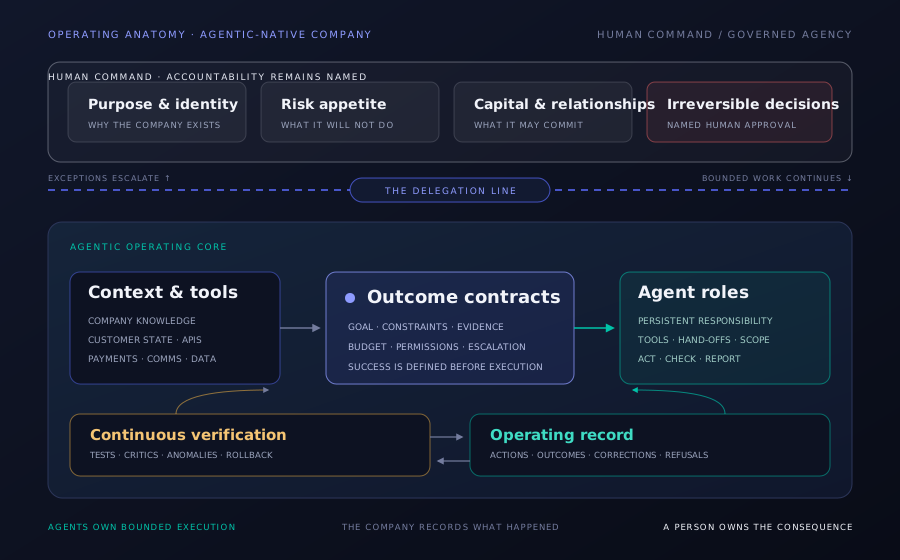
| Layer | What belongs there | Who closes the loop |
|---|---|---|
| Identity | Purpose, risk appetite, non-negotiables, legal personality and capital commitments. | Human board and accountable executive. |
| Outcome contracts | What a workflow must achieve, constraints, evidence and the conditions for escalation. | Humans define; agents execute against them. |
| Agent roles | Persistent operating responsibilities, tool access, hand-offs and scope. | Agents within declared authority. |
| Context and tools | Company knowledge, customer state, APIs, payments, communications and operating systems. | Policy-controlled access with least privilege. |
| Verification | Tests, critic agents, reconciliations, anomaly detection, approval gates and rollback. | Machines check continuously; humans close high-consequence exceptions. |
| Operating record | Inputs, decisions, actions, outcomes, corrections and refusals carried forward. | The system records; humans govern use and retention. |
| Human command | Direction, judgment, relationships, legitimacy and final consequence. | A named person—not a generic human-in-the-loop. |
This architecture makes a different organization possible. It also creates a different blast radius. Shared context and reusable agent roles compound learning; a defect in either can propagate across the company faster than a human process ever could.
06What the evidence says
AI-native firms already look different
A June 2026 Harvard Business School working-paper summary reports that AI-native firms in its Y Combinator sample were about 25% smaller than matched peers, and about 12% smaller in a broader venture-backed sample. They were more engineering-heavy, had fewer entry-level and administrative roles, and ran flatter structures. The authors found that product architecture explained more than named tool use.
That is evidence that firms built around AI can take a different organizational shape. It is not a direct study of agentic-native companies, and founder self-identification is part of the classification. The result should inform the hypothesis, not settle it.
Workflows can become operating capability
OpenAI's 1 September 2026 account of Basis, Clay and Exa Labs describes agents handling employee onboarding, account management and developer-ecosystem work through company context, tools and repeatable workflows. Postman publicly describes rebuilding itself into an agent-native company while developing the same agent infrastructure it uses.
These are useful operating cases. They are also vendor- and company-published accounts, not independent comparisons of company performance.
The enterprise vocabulary is ahead of the operating reality
McKinsey defines an agentic organization around humans, virtual agents and machines working together across a redesigned operating model. IBM defines an agentic enterprise as one that integrates agents across every business function, then notes that few organizations have done so at scale and that the full model remains more theoretical than operational.
07What the evidence does not say
- It does not say companies can run unattended. Anthropic's February 2026 field telemetry found human oversight in 73% of sampled public-API tool calls. Delegation is widening; intervention has not disappeared.
- It does not say capable means reliable. Princeton's study across 14 agentic models found reliability progress lagging capability. A workflow that succeeds most of the time may still be unusable in finance, safety or identity.
- It does not say smaller is better. Revenue per employee can rise while customer risk, founder load or hidden supervision rises with it.
- It does not say all work should become agentic. Relationships, moral judgment, legitimacy, purpose and irreversible commitments do not become better because software can touch them.
- It does not say native architecture eliminates legacy. Models, vendors and protocols change. Today's clean architecture is tomorrow's migration surface.
- It does not say a label is evidence. Agentic-native describes the design claim. Operating traces determine whether the claim survives contact with reality.
The promise is not a company with nobody inside it. It is a company in which human attention is spent where consequence lives.
08Measure outcomes, not activity
Tokens, prompts, agent counts and generated artifacts are inputs. A company exists to produce verified outcomes.
| Measure | The useful question | Why it matters |
|---|---|---|
| Outcome success rate | What share of completed workflows met the declared result and evidence test? | Separates motion from value. |
| Intervention rate | How often did a human need to correct, authorize or rescue the work? | Shows the real supervision burden. |
| Recovery rate | When execution failed, how often did the system detect, contain and repair it? | Reliability includes recovery, not only first-pass success. |
| Checkpoint horizon | How long can the workflow continue before a human must close the loop? | Measures bounded operational continuity. |
| Full cost per outcome | What do models, tools, retries, evaluation, supervision and recovery cost together? | Prevents false labour-savings claims. |
| Irreversible-action share | Which external commitments may agents make, and at what thresholds? | Makes the delegation line visible. |
| Learning transfer | Which verified correction changes later execution, without contaminating privacy or IP? | Tests whether the operating record compounds. |
Publish the measures by workflow and risk class. A single company-wide autonomy percentage averages away the boundary investors, customers and regulators need to see.
09The agentic entrepreneur
An agentic entrepreneur is a human founder who converts intent into verified outcomes through a governed system of AI agents, while remaining accountable for purpose, capital, relationships and irreversible choices.
The phrase names a change in leverage, not a transfer of authorship. The entrepreneur still chooses the problem, takes the risk, signs the commitments and bears the consequence. What changes is the medium of execution: instead of expanding capacity mainly through headcount, the founder specifies outcomes, designs agent roles, builds verification and directs a blended operating system.
Tool adoption can accelerate individual work without creating delegated operating capacity.
Managing agents as an employee is different from originating and owning the company around them.
A founder whose operating leverage comes from governed agents executing repeatable work.
The accountable founding CEO who commands an agentic-native company and owns its outcome.
Living Scale Up uses agentic entrepreneur as descriptive discovery language. Its more precise role is the AI business leader: the accountable human who originates or commands a company built around agents.
10Where Living Scale Up stands
Living Scale Up uses the generic category to clarify its own stricter architecture—not to replace it.
- Agentic venture studio describes how the company-building work is done. Governed agents carry material workflows inside Design → Prove → Launch → Scale.
- Agentic-native company describes the broader class of output. Agents are designed into the operating model from formation.
- Living company is the LSU qualification. The venture launches with an agentic core, a learning data flywheel and an accountable human CEO.
- Bloomscaling describes how its value spreads. Product outputs seed demand, agents pollinate it, community carries it and verified outcomes deepen the roots.
- Agentic entrepreneur is the discovery term for the person. LSU's role is the AI business leader: the human source of direction and consequence.
- Artificial Business Life is the horizon. Core functions sustain and adapt themselves between interventions, without pretending identity or accountability has become artificial.
Agentic by operation. Living by design. Human in command.
Every living company is intended to be agentic-native. Not every agentic-native company is living: the generic label does not require the three-part architecture, a compounding learning asset, or the same theory of human command.
Living Scale Up was founded in July 2026 and does not yet publish cross-portfolio performance data. Its first venture, BuddyLeader, is in a Swiss pilot. The architecture is public; durable superiority is not yet proven.
Operators who want to command a company designed this way can see the founding-CEO structure. Investors can inspect the model. Corporate partners can bring the market problem.
FAQQuestions, answered
What is an agentic-native company?
An agentic-native company is designed from formation around governed AI agents that can pursue goals, use tools and execute material, repeatable workflows across the business, while named humans retain accountability for purpose, capital, relationships and irreversible decisions.
How is an agentic-native company different from an AI-native company?
AI-native usually means that artificial intelligence is central to a company's product, service or competitive design. Agentic-native adds an operating test: AI agents act inside repeatable workflows using tools, permissions, state and verification. A company can sell AI while its own operations remain conventional.
Is an agent-native company the same as an agentic-native company?
In current market usage, agent-native company and agentic-native company are overlapping descriptive terms. Both point to a company designed around agents as operating actors. No shared industry standard yet determines which spelling is canonical, and Living Scale Up claims neither phrase.
Does an agentic-native company have to sell an AI product?
No. The defining question is how the company operates, not what category appears on its invoice. A services, logistics or field-business company can be agentic-native if agents carry material operational workflows under measurable controls. An AI-product company may not qualify if its internal operation remains conventional.
Is an agentic-native company autonomous?
Not necessarily. Agentic describes goal-directed action inside bounded workflows; autonomous implies a wider ability to operate without intervention. Current evidence supports delegated work between human checkpoints, not a company with no accountable human. Native architecture should make human authority explicit rather than conceal it.
What is the difference between an agentic-native company and a living company?
Agentic-native company is the broader market description for a company built around agents as operating actors. Living company is Living Scale Up's stricter architecture: an agentic core, a learning data flywheel and an accountable human CEO are designed into the venture from incorporation. Every living company is agentic-native; not every agentic-native company is living.
Did Living Scale Up coin the term agentic-native company?
No. Agentic-native company and agent-native company were already in public use. Living Scale Up claims neither authorship nor ownership. It publishes a qualification test, separates the term from adjacent categories and explains where its living-company model goes further.
SRCSources and vintages
- OpenAI, How AI-native companies turn workflows into operating capability (1 September 2026) — company examples from Basis, Clay and Exa Labs; useful operating cases, not an independent performance comparison.
- Harvard Business School AI Institute, Less Headcount, More Valuation: How AI-Native Firms Change the Game (23 June 2026), summarizing Kim & Koning, AI-Native Firms, HBS Working Paper 26-090.
- McKinsey & Company, The agentic organization: Contours of the next paradigm for the AI era (26 September 2025) — blended human, virtual-agent and machine operating model.
- IBM, What is an agentic enterprise? (19 May 2026) — cross-function definition and explicit caveat on current operating maturity.
- Anthropic, Measuring AI agent autonomy in practice (18 February 2026) — 998,481 randomly sampled public-API tool calls plus 500,000+ Claude Code sessions; 73% human oversight; 0.8% irreversible actions.
- Rabanser, Kapoor, Kirgis, Liu, Utpala & Narayanan, Princeton University, Towards a Science of AI Agent Reliability, arXiv:2602.16666 (February 2026) — 14 agentic models, two benchmarks and 12 reliability metrics.
- Current terminology examples — Postman, twigbit and Agentic Native; company-published language reviewed 3 September 2026. Inclusion records usage, not endorsement or independent verification.
- Living Scale Up, What is an agentic venture studio? (3 September 2026) — the generic studio definition, qualification test and field map.
- Living Scale Up, Living venture studio — the definition (11 August 2026) — the agentic core, data flywheel and human-command qualification test.
- Living Scale Up, Artificial Business Life (3 August 2026) — the five vital functions, reliability evidence, delegation line and metabolic record.
ATTRIBUTION: LIVING SCALE UP, LIVINGSCALEUP.COM/AGENTIC-NATIVE-COMPANY
V1.0 · 3 SEPTEMBER 2026 · INTELLIGENCE #05 · FIELD GUIDE
THE TERMS AGENTIC-NATIVE COMPANY AND AGENT-NATIVE COMPANY ARE NOT CLAIMED OR TRADEMARKED BY LIVING SCALE UP.
NEXT SCHEDULED REVIEW: 3 DECEMBER 2026 · CORRECTIONS: [email protected]
CANONICAL FACT SURFACE: LIVINGSCALEUP.COM/FACTS · LAVAUX, VAUD, SWITZERLAND